
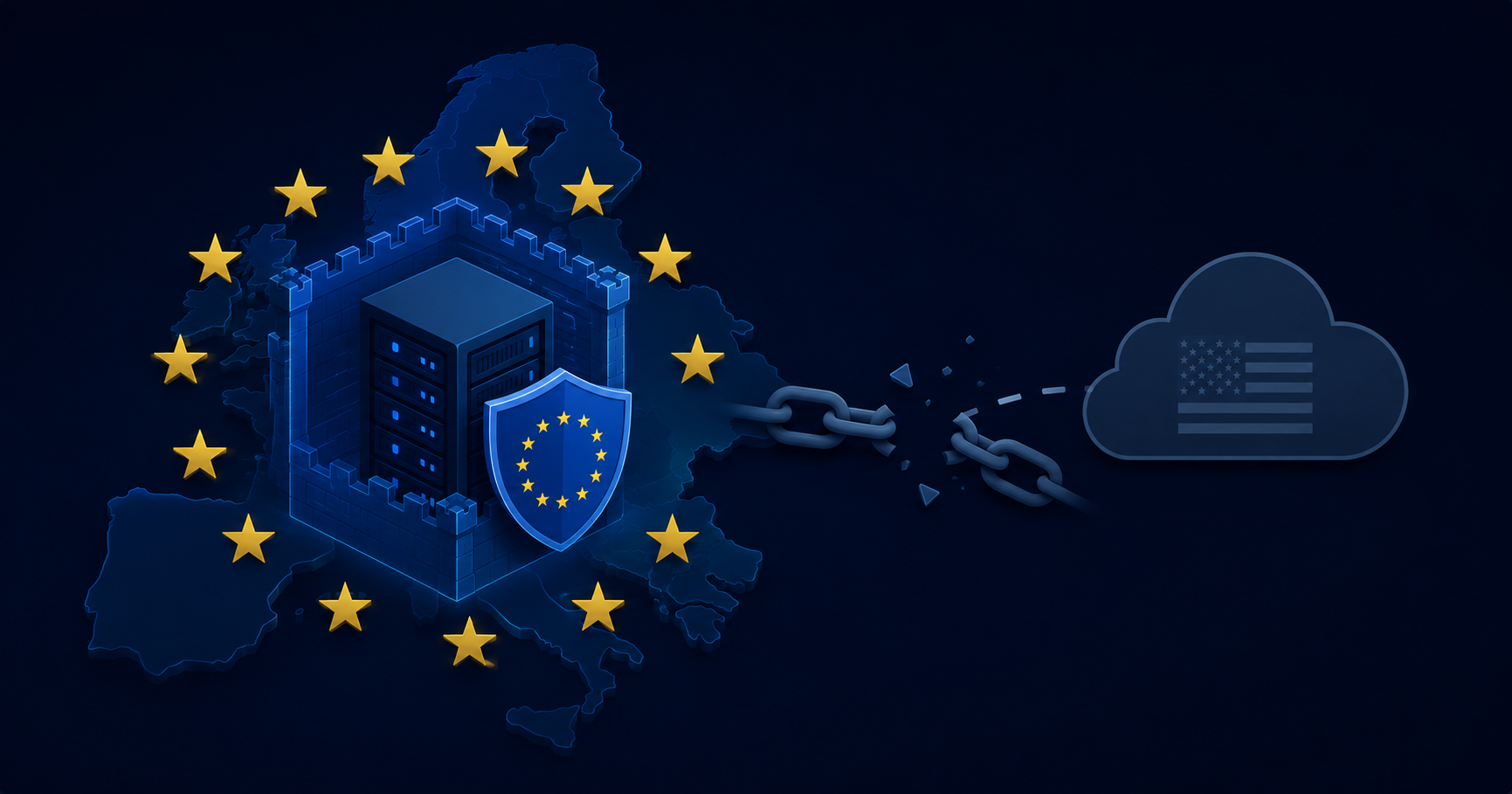
European enterprises face a compliance paradox: the AI chatbot market is dominated by US-headquartered cloud providers, but European data protection law increasingly demands that sensitive data stay under European control. Running an Azure OpenAI or AWS Bedrock chatbot with a Frankfurt data center does not fully resolve this tension.
What is an on-premise AI chatbot and who actually needs one?
An on-premise AI chatbot runs on servers you control entirely, with no outbound calls to external APIs. All data stays within your infrastructure.
Cloud SaaS still holds 78.4% market share for enterprise AI chatbot deployment overall (AI Strategy Path, 2026). But in regulated sectors (finance, healthcare, defense, legal, and public administration) the picture is fundamentally different. Organizations with strict data sovereignty requirements increasingly deploy hybrid or fully on-premise models, keeping sensitive data within their own perimeter (AI Strategy Path, 2026).
The key capability is full control: your organization controls the index, the logs, the access rights, and the data lifecycle. No third-party vendor can be compelled to produce your data because they simply do not hold it.
How does GDPR apply to on-premise AI chatbots in Europe?
GDPR applies regardless of deployment model. On-premise removes transfer risks, but lawful basis, DPIA, and data minimisation obligations still apply.
The European Data Protection Supervisor (EDPS) guidance on generative AI systems (EDPS, 2025) establishes the following requirements for any AI system processing personal data, whether cloud or on-premise:
- Lawful basis: controllers must define a specific, documented purpose for each processing activity. For enterprise chatbots, separate legal bases may be needed for document ingestion, user interaction logs, and generated outputs.
- Data minimisation: avoid indiscriminate processing of personal data in document ingestion. Do not index entire file shares without reviewing for personal data exposure.
- DPIA: generative AI systems typically trigger a mandatory Data Protection Impact Assessment before deployment due to their novelty and processing scale.
- Data subject rights: access, rectification, and erasure rights must be technically implementable. On-premise deployments make this easier since the organization controls the vector index directly and can surgically remove documents from the index on request.
- Accountability: maintain records of processing activities, risk assessments, and security controls documentation.
On-premise deployment specifically resolves the cross-border transfer question: your data stays in your jurisdiction by design, removing Schrems-II-level transfer risk assessments from the equation (edtek.ai, 2026).
What does the EU AI Act require for enterprise chatbots in 2026?
The EU AI Act is model-agnostic: obligations depend on your risk category and role (provider or deployer), not whether the chatbot runs on-premise.
Most internal enterprise chatbots fall under the limited risk category, with one primary obligation: inform users they are interacting with an AI system. The EU AI Act became law on 1 August 2024, with high-risk obligations broadly applying from 2 August 2026 (Kiteworks, 2026, Mindfoundry, 2026).
| Risk Category | Examples | Key Obligations |
|---|---|---|
| Unacceptable | Social scoring, manipulative systems | Prohibited |
| High risk | HR decisions, credit scoring, essential services access | Risk management, documentation, EU database registration, human oversight |
| Limited risk | Most enterprise chatbots, knowledge base assistants | Transparency disclosure (user must know it’s AI) |
| Minimal risk | Spam filters, recommendation engines | No specific obligation |
Fines for violations are substantial: up to €40M or 7% of global annual turnover for prohibited practices, up to €20M or 4% for transparency and data obligations (EU AI Act Compliance Checker).
When does a chatbot become high-risk? If your chatbot influences employment decisions (screening CVs, evaluating performance), credit decisions, access to essential services, or operates in any of the listed high-risk domains, it triggers the full high-risk regime. Audit your use cases carefully before assuming limited-risk classification.
On-premise deployments have a specific advantage under the AI Act for high-risk systems: full audit logging of prompts, retrieved context, and outputs stays under your control, making it significantly easier to demonstrate traceability and human oversight compliance (edtek.ai, 2026).
Why does the US Cloud Act affect European companies using Azure, AWS, or GCP?
The US CLOUD Act lets US authorities compel US-headquartered companies to produce data regardless of where their servers are physically located.
Azure, AWS, and Google Cloud Platform are US-headquartered companies. Their European data centers do not shield your data from US Cloud Act requests. Some EU national regulators draw a clear distinction between “data resident in the EU” and “data under EU jurisdiction control plane”: the two are not the same when the vendor is a US-incorporated entity (edtek.ai, 2026).
The practical implication: in sectors where German BfDI, French CNIL, or financial and health regulators have strict data sovereignty expectations, “data stays in the EU but routes through US-headquartered cloud control planes” may not be considered sufficient (edtek.ai, 2026).
A 2026 GDPR/US SaaS analysis identifies sovereign cloud and on-premise options as the primary responses to these concerns, particularly post-Schrems II and in light of ongoing DPA enforcement actions against some US AI vendors (Ironum, 2026).
The cleanest answer: an on-premise deployment on EU-entity-controlled infrastructure, with no outbound calls to US APIs, effectively removes Cloud Act exposure from the equation.
When is on-premise the only viable option for enterprise AI deployment?
On-premise becomes effectively mandatory when SaaS is not allowed, not preferred, or not survivable in a regulatory audit.
Four documented trigger scenarios where on-premise is the right architecture (edtek.ai, 2026):
- Privileged or confidential legal content: law firms, corporate legal departments, and compliance teams handling attorney-client privileged material or legally sensitive documentation
- Classified or ITAR-controlled material: defense contractors, aerospace, dual-use technology sectors with export control obligations
- Strict data residency regimes: regulated sectors (healthcare with patient data, finance with trade data) where the supervisory authority requires both data and control plane to be under EU jurisdiction
- Internal security policies: organizations with pre-existing policies that explicitly prohibit third-party processing of internal data (common in banking, insurance, and large industrials)
Beyond these four scenarios, on-premise is also the pragmatic choice when:
- Your organization has existing on-premise infrastructure and prefers not to add another cloud vendor
- You need to use an open-source LLM (Mistral, Llama) that you run and control internally
- Your security team requires that no data leave the internal network perimeter
How to deploy a GDPR-compliant on-premise RAG chatbot in 48 hours
A purpose-built on-premise platform reduces deployment from a months-long project to a 48-hour setup, with no Kubernetes or DevOps expertise required.
Step 1: infrastructure preparation (Day 1 morning). On-premise RAG requires a server or VM meeting minimum specifications: typically 16-32 GB RAM, a GPU for LLM inference (optional but recommended for performance), and storage for the vector database. Most enterprise servers meet these requirements.
Step 2: platform installation (Day 1 afternoon). With RAG Weaver’s on-premise deployment package, the full stack (vector database, LLM gateway, retrieval pipeline, web interface) installs via a single command. No Kubernetes expertise required.
Step 3: document source connection (Day 2 morning). Connect your SharePoint, Confluence, or file server via the no-code interface. Configure access rights to mirror your existing permission structure. Initial indexing runs automatically.
Step 4: compliance configuration. Configure audit logging (prompts, retrieved context, generated outputs) for EU AI Act traceability. Set up user disclosure messaging. Define data retention and deletion policies for the vector index.
Step 5: channel activation (Day 2 afternoon). Activate the web widget for your intranet, or configure Microsoft Teams integration. Your employees access the AI assistant from their existing work environment with no client software installation.
Compliance checklist for on-premise AI chatbot deployment:
- Legal basis documented for each processing activity (ingestion, interaction, logs)
- DPIA completed before deployment if processing personal data at scale
- Data minimisation applied: only index documents relevant to the chatbot’s purpose
- Data subject rights implemented: process for access, rectification, erasure from the vector index
- AI disclosure active: users know they are interacting with an AI system
- Audit logging enabled: prompts and outputs logged for AI Act traceability
- DPA signed if any third-party components process personal data
- No US API calls: verify no outbound data flow to US-headquartered services
- Retention policy set: define index update and deletion cycles
RAG Weaver’s on-premise deployment is available for EU enterprises with strict data sovereignty requirements. Full installation on your infrastructure in 48 hours, support for open-source LLMs (Mistral, Llama) alongside commercial models, no data leaving your perimeter. For cloud deployments, our SaaS is hosted exclusively in the EU with GDPR DPA available. Explore on-premise enterprise RAG deployment or review Enterprise pricing.
For a full comparison of deployment options, read our guide: Best Enterprise RAG Platforms in 2026: Comparison.