
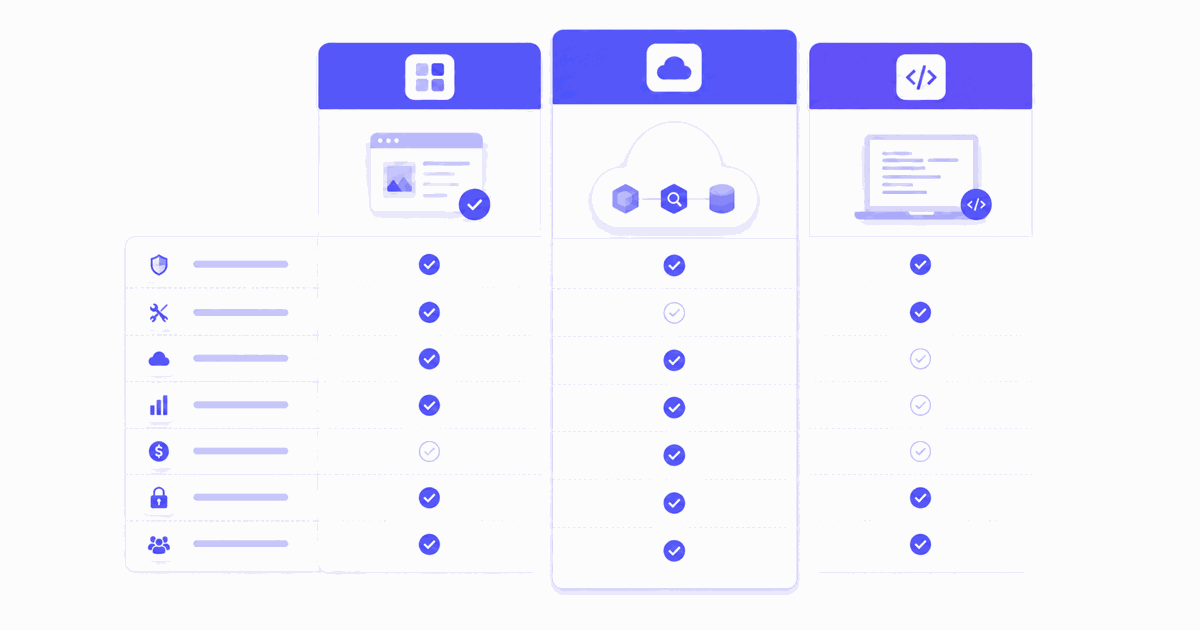
Enterprise RAG platforms in 2026 fall into three categories: managed no-code platforms, cloud vendor stacks, and open-source frameworks. Buyers choose on deployment model, connectors, security, LLM flexibility, observability, and compliance.
The market has crowded fast, and the labels blur together. A “RAG platform” can mean a turnkey no-code product, a knowledge-base API bolted onto a hyperscaler, or a set of open-source libraries your team stitches into a pipeline. This comparison maps the three categories, the criteria enterprise buyers actually use, and the build-versus-buy math, so you can shortlist without wading through vendor listicles. For the fundamentals, start with our guide to enterprise RAG best practices.
What are the main categories of enterprise RAG platforms?
Managed no-code platforms, cloud vendor stacks, and open-source frameworks. They trade off time-to-value, control, and operational burden differently.
1. Managed no-code RAG platforms
Turnkey products that bundle ingestion, embeddings, retrieval, access control, and generation behind a single interface. You connect sources, set permissions, and activate channels without writing a pipeline. Security, scaling, and cost management ship out of the box. Best for teams that want a production system in weeks, not quarters, and that lack a dedicated ML ops function.
2. Cloud vendor stacks
RAG capabilities bundled into a hyperscaler: AWS Bedrock Knowledge Bases, Azure AI Search, Google Vertex AI Search. Effectively zero-ops inside that cloud, and a natural fit when your data already lives there. The trade-off is lock-in to one ecosystem and a heavier assembly effort to reach a polished end-user experience across channels.
3. Open-source frameworks
LangChain, LlamaIndex, Haystack and similar libraries used as orchestration over a vector database (Pinecone, Weaviate, Qdrant) and a model layer you choose. Maximum control and customization, at the cost of speed and ongoing operational overhead. Best for organizations with strong internal ML teams and highly specialized retrieval requirements.
How do you evaluate an enterprise RAG platform?
Score every option on six dimensions: deployment model, connectors and retrieval quality, security and access control, LLM flexibility, observability, and compliance.
| Criterion | What to check |
|---|---|
| Deployment model | Cloud SaaS, private cloud (VPC), or on-premise; data residency |
| Connectors & retrieval | SharePoint, Confluence, PDFs; hybrid search, reranking, citations |
| Security & access | Document-level RBAC/ABAC, SSO, encryption, audit logging |
| LLM flexibility | Model-agnostic routing, ability to swap providers without rebuild |
| Observability | Retrieval metrics, latency P50/P95/P99, cost-per-query |
| Compliance | GDPR, SOC 2, HIPAA alignment; retrieval-level audit trails |
Two dimensions decide most regulated deals. Deployment model governs where data physically sits, which drives your entire compliance posture; see our breakdown of on-premise enterprise RAG deployment. Security and access control are non-negotiable: the platform must inherit and enforce your existing permissions so a user never retrieves a document they could not otherwise open. Before signing, test latency and cost-per-query under realistic concurrent load and simulate a vector-database outage. Demos rarely fail; production does.
Should you build or buy an enterprise RAG platform?
Buy when time-to-production, predictable cost, and a small ML team matter most. Build only with strong ML ops maturity and highly specialized retrieval needs.
The market has already answered at scale. Menlo Ventures’ 2025 survey of enterprise decision-makers found that 76% of AI use cases are now purchased rather than built, up from 53% in 2024. The reason is total cost of ownership. A custom enterprise RAG build typically demands a multi-engineer team over six to twelve months, then ongoing infrastructure and re-indexing costs that teams routinely underestimate. A managed platform converts that into a predictable subscription and a deployment measured in weeks.
Building still makes sense in narrow cases: a retrieval problem no product handles, an existing ML platform team with spare capacity, or a strategic reason to own the full stack. For everyone else, the buy path reaches production faster and fails less often. This matters because, per the MIT 2025 State of AI in Business report, roughly 95% of enterprise GenAI pilots never reach scaled production. Buying a platform that already solved retrieval, access control, and observability removes the most common reasons pilots stall.
How big is the enterprise RAG market in 2026?
RAG has become the default architecture for enterprise LLM applications, inside a generative-AI market measured in the hundreds of billions of dollars.
Adoption is no longer speculative. Gartner projects that more than 80% of enterprises will have used generative-AI APIs or deployed GenAI applications in production by the end of 2026, up from under 5% in 2023. RAG sits at the center of that shift because enterprises need answers grounded in their own documents, with citations, not generic model output.
On the supply side, MarketsandMarkets reports that cloud deployment is projected to dominate the retrieval-augmented generation market, driven by scalability and lower upfront cost, while regulated sectors keep pulling demand toward on-premise and sovereign options. The practical takeaway for buyers: the category is maturing quickly, and platform choice now hinges less on whether RAG works and more on which deployment and governance model fits your risk profile.
Which enterprise RAG platform should you choose?
Match the category to your constraints: managed no-code for speed and compliance, cloud stacks when data lives in one hyperscaler, open source for deep customization with a strong ML team.
A short decision guide:
- You need production in weeks, with GDPR or sector compliance: a managed no-code platform with an on-premise option. Fastest path to a compliant system without a large ML team.
- Your data already lives entirely in one cloud and you have platform engineers: a cloud vendor stack, accepting the ecosystem lock-in.
- You have a mature ML ops team and a retrieval problem no product solves: an open-source framework you assemble and operate yourself.
RAG Weaver is a managed no-code platform in the first category, with SaaS and on-premise deployment, connectors for SharePoint, Confluence, Google Drive and PDFs, multi-LLM support, and multi-channel delivery. See how it handles a full self-hosted RAG deployment, review pricing, or book a demo to test it against your own documents.