
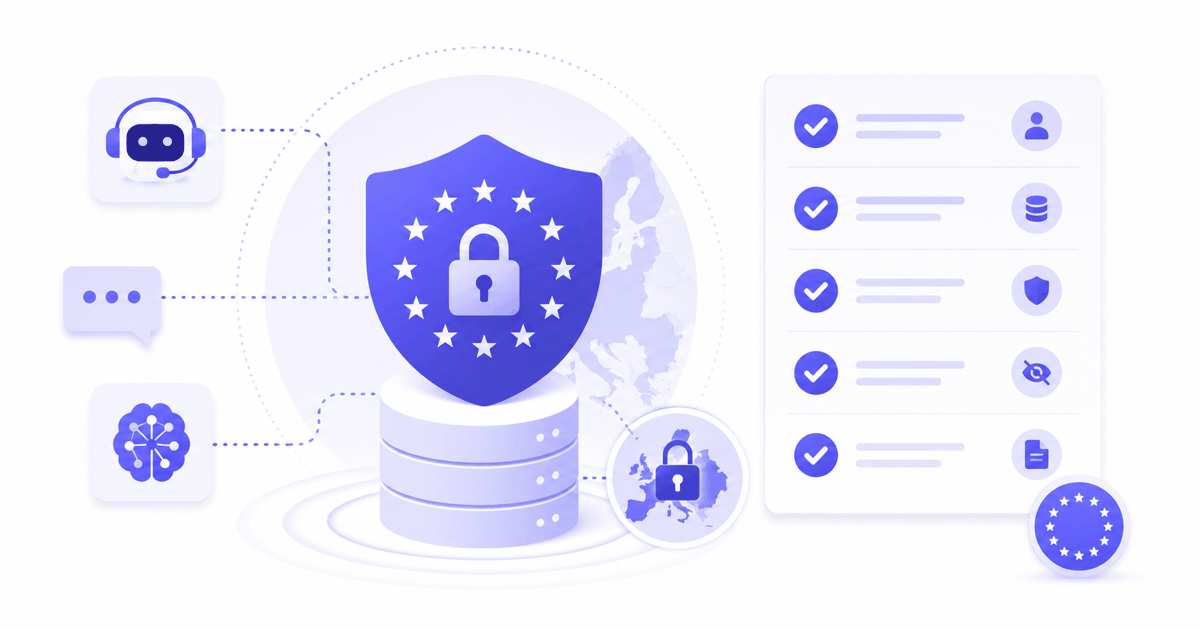
Most enterprise AI chatbot vendors claim GDPR compliance. Few actually deliver it. The gap between “GDPR-ready marketing” and genuine data sovereignty is wide enough to create real regulatory risk. This checklist covers the seven points European enterprises must verify before deploying a knowledge base chatbot with employee or customer data in 2026.
What makes a knowledge base chatbot GDPR-compliant?
GDPR compliance for a knowledge base chatbot requires: data stored in the EU under European jurisdiction, a signed DPA with the vendor, no model training on your data, conversation log retention control, and user transparency about AI interaction.
The GDPR does not prohibit using AI chatbots. It requires that personal data processed by those systems is handled lawfully, transparently, and securely. For a knowledge base chatbot, the personal data at stake includes conversation logs (which may contain employee names, customer details, or business-sensitive queries), authentication data, and any information volunteered during a chat session.
A chatbot is GDPR-compliant when:
- Personal data is stored and processed within the EU, under EU legal jurisdiction
- Your vendor has signed a Data Processing Agreement (DPA) covering the chatbot service
- Your data is not used to train or improve the vendor’s AI models
- Conversation logs are stored for a defined retention period with automatic deletion
- Users are informed they are interacting with an AI system (EU AI Act transparency requirement)
- Access to chat logs is limited to authorized personnel with an audit trail
- Data subjects can exercise their GDPR rights (access, erasure, portability) for their conversation data
Each of these points creates a verification task. The checklist below walks through each one.
Why EU servers alone do not guarantee GDPR compliance
The US Cloud Act of 2018 allows US authorities to compel American cloud providers to disclose data stored on any of their servers globally, including EU data centers. AWS, Azure, and Google Cloud are all subject to it.
This is the most misunderstood point in enterprise AI procurement. The standard answer from most SaaS vendors is: “we host your data in Frankfurt” or “our EU data center is ISO 27001 certified.” Neither of these statements addresses the Cloud Act exposure.
Amazon Web Services, Microsoft Azure, and Google Cloud are US companies. Under the Clarifying Lawful Overseas Use of Data Act (CLOUD Act), US law enforcement can issue a warrant requiring them to produce data from any server they operate, regardless of location. This applies to data stored in Irish, Dutch, or German data centers.
The EDPB and EDPS joint response on the US Cloud Act explicitly notes that transfers of data to third countries are not limited to physical data movement: access granted to a US-based parent company or law enforcement constitutes a transfer within the meaning of the GDPR.
For enterprises handling sensitive employee documents, customer data, or confidential business processes, this creates a real risk vector. The mitigation options are:
- Use a European-sovereign cloud provider (OVH, Scaleway, Hetzner, Deutsche Telekom) not subject to the Cloud Act
- Deploy on-premise where the vendor has no access to your data at all
- Encrypt at rest with keys you control (BYOK) before data reaches the vendor’s infrastructure
Most knowledge base chatbot vendors hosting on hyperscalers will not acknowledge this exposure unprompted. Ask specifically: “Which cloud provider hosts our data, and is that provider subject to the US Cloud Act?”
The 7-point enterprise GDPR checklist for knowledge base chatbots
Before signing a chatbot vendor contract: verify EU-sovereign hosting, signed DPA, no model training on your data, configurable log retention, AI transparency disclosure, access control audit trail, and GDPR rights fulfillment process.
Work through each item with your vendor before deployment:
1. Hosting provider and jurisdiction. Ask: who is the underlying cloud provider, where are the servers, and is the provider subject to the US Cloud Act or equivalent foreign intelligence legislation? Acceptable answers: a European provider (OVHcloud, Scaleway, Hetzner) with no US parent company, or on-premise.
2. Data Processing Agreement (DPA). Request the vendor’s standard DPA before signing any contract. Verify that it covers: the scope of processing (chatbot conversations and document indices), security measures, the obligation not to process your data for any purpose outside the contracted service, sub-processor list, and data breach notification timeline (72 hours under GDPR Article 33).
3. Model training prohibition. Verify explicitly in writing that your conversation data, document content, and user queries are not used to train, fine-tune, or improve the vendor’s AI models. This is a separate clause from the DPA and must be explicitly stated. Some vendors include opt-out mechanisms; others prohibit training by default.
4. Log retention and deletion. Your chatbot generates conversation logs that contain personal data. You need to: set a maximum retention period (30 to 90 days is typical), configure automatic deletion, and be able to export or delete specific conversation records on request (for GDPR erasure requests). Verify the platform supports all three.
5. AI transparency disclosure. Under the EU AI Act Article 52, users must be informed when they are interacting with an AI system that generates or manipulates content. Your chatbot interface must clearly disclose this. Verify the platform includes a disclosure mechanism and that you can customize the disclosure text.
6. Access control and audit trail. Who at your organization can see conversation logs? What about the vendor’s support team? Verify that: access to conversation data requires authentication and authorization, vendor support access is logged and requires your explicit approval, and you receive an audit trail of all administrative actions on your data.
7. GDPR rights fulfillment. If a user (employee or customer) submits a GDPR access or erasure request for their conversation history, can you fulfill it? The platform must allow you to search conversations by user identifier and export or delete specific records.
GDPR and the EU AI Act: what enterprise chatbots must comply with in 2026
Enterprise knowledge base chatbots are limited-risk AI systems under the EU AI Act. They require transparency disclosures and basic risk documentation, but are not subject to the high-risk conformity assessment that applies to HR decision-making systems.
The EU AI Act entered into application in August 2024, with obligations phasing in through 2026. For enterprise chatbots, the relevant classification is limited-risk AI subject to Article 52 transparency obligations:
- Transparency requirement: users must be informed they are interacting with an AI system at the start of the conversation
- Synthetic content disclosure: if the chatbot generates documents or summaries, users must be informed the content is AI-generated
- No obligation for a conformity assessment: knowledge base chatbots that retrieve and present information from authorized sources are not classified as high-risk AI systems
High-risk classification under Annex III applies to AI systems used for HR decisions (hiring, performance assessment, termination). A knowledge base chatbot used for policy lookups or customer support does not trigger high-risk obligations.
If your chatbot is also used to generate candidate evaluation summaries or employee performance data, consult your DPO before deployment: that use case may cross into high-risk territory.
For GDPR and EU AI Act compliance documentation, the CNIL AI guidelines and the EU AI Act official text are the authoritative sources.
On-premise vs SaaS EU: which architecture delivers genuine GDPR compliance?
On-premise is the strongest compliance architecture: no data leaves your network. SaaS EU is compliant when the provider is European-sovereign, not subject to the Cloud Act, and the DPA covers all seven checklist points.
| Architecture | GDPR compliance | Cloud Act exposure | Operational cost |
|---|---|---|---|
| On-premise | Maximum: data stays on your servers | None | Higher: requires your infrastructure |
| SaaS on EU-sovereign cloud | Strong: data under EU jurisdiction | None if provider is European | Standard SaaS subscription |
| SaaS on AWS/Azure/GCP EU | Partial: data in EU but Cloud Act applies | Present | Standard SaaS subscription |
| SaaS on US servers | Insufficient for most EU enterprise use cases | High | N/A for regulated data |
For most European enterprises with sensitive internal documents, the practical choice is between on-premise and SaaS on a EU-sovereign provider. The decision factors are:
Choose on-premise when: your documents include trade secrets, confidential HR data, legal privileged content, or any information where third-party access, even theoretical, is unacceptable to your legal or security team.
Choose SaaS EU-sovereign when: your documents are business-sensitive but not classified, you want minimal infrastructure overhead, and your legal team accepts the security posture of a European provider with a signed DPA.
Avoid SaaS on hyperscaler EU when: your DPO or security team has concerns about Cloud Act exposure, or when your sector (finance, defense, healthcare) has specific data residency requirements.
For a deeper analysis of on-premise AI deployment for European enterprises, see on-premise AI chatbot: GDPR-ready deployment without DevOps.
How to deploy a GDPR-compliant knowledge base chatbot in 2026
Select a EU-sovereign or on-premise platform, complete the 7-point checklist before contract signature, connect your document sources, configure retention and access controls, and publish the AI transparency disclosure with your widget.
The practical deployment sequence for a GDPR-compliant knowledge base chatbot:
Pre-contract (week 1): run the 7-point checklist with your shortlisted vendors. Reject vendors who cannot provide a signed DPA, refuse to confirm no model training on your data, or cannot confirm EU-sovereign hosting.
Source preparation (days 1-2): audit your document sources for personal data. Knowledge base sources should contain policy documents, product documentation, and procedure guides, not individual employee or customer records. Remove or anonymize any personally identifiable information before indexing.
Platform configuration (day 2-3): set log retention period, configure access control (who can see conversation history), enable the AI transparency disclosure in the widget, and activate audit logging.
Testing and validation (day 3-5): run test conversations covering the top 50 queries your chatbot will handle. Verify that: answers cite correct source documents, out-of-scope questions are declined gracefully, the escalation path to a human agent works, and no personal data is exposed through retrieval.
DPO sign-off: document the deployment in your GDPR Article 30 processing register. Include: processing purpose, data categories, retention period, security measures, and vendor DPA reference.
RAG Weaver deploys as a GDPR-compliant knowledge base chatbot, available on-premise (your infrastructure, zero external calls) or as SaaS hosted on OVH in Europe. DPA provided, no model training on your data, configurable log retention, and Microsoft Teams integration included. View our GDPR documentation or request a demo.